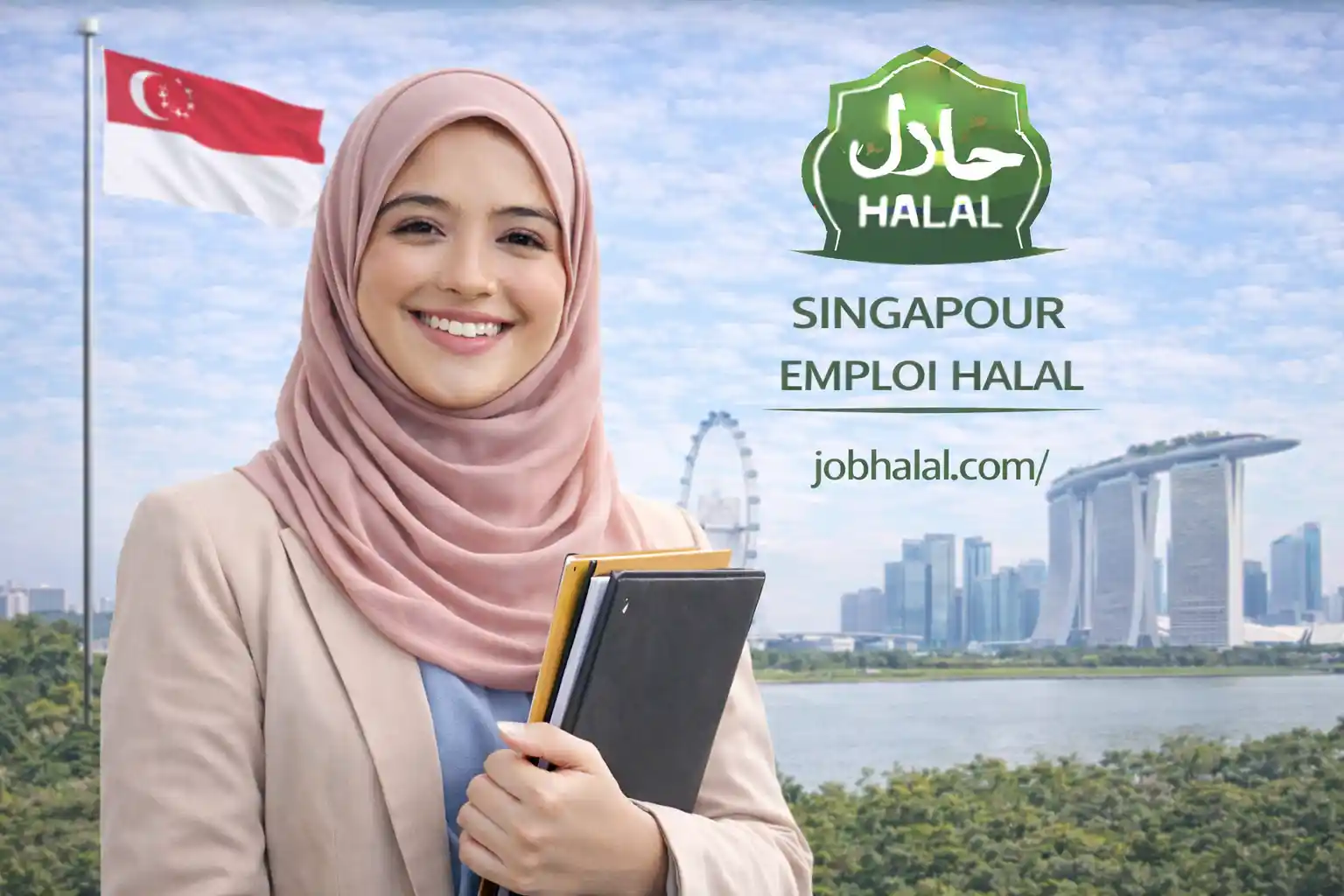
Singapore is a cosmopolitan city-state renowned for its efficiency and stability. Muslims, the great majority of them Malay, form a large and well-organised minority, with an official religious council that manages, among other things, halal certification. For a foreign professional, the city offers opportunities in finance, regional trade, technology and hospitality, provided you meet its selective immigration criteria.
The local context, the sectors of interest to an applicant who cares about lawfulness, the employment framework and the general rules of access all shape a job search here.
Halal life for an integrated Muslim minority
Singapore's population is predominantly of Chinese origin, with large Malay and Indian communities. Muslims make up a significant proportion of residents. The Majlis Ugama Islam Singapura (MUIS), the Islamic Religious Council established by law, manages mosques, zakat, certain religious matters and halal certification. English is the working language; Malay, Mandarin and Tamil are also official languages.
Public policy places strong emphasis on harmony between religious and racial communities, which translates into considerable restraint on these subjects in the workplace.
Halal in food service and the food industry
MUIS certification covers restaurants, central kitchens, factories and products. The major fast-food chains, food courts and many caterers are certified to serve local and visiting Muslim customers. Certified companies need staff trained in halal requirements, quality managers and internal auditors. The city also serves as a regional base for manufacturers exporting to Indonesia and Malaysia. Related roles are described under halal food production and the halal supply chain.
Finance and regional services
As a global financial centre, Singapore hosts Islamic finance activities (sukuk, compliant funds, wealth management), although these remain more modest than in neighbouring Malaysia. The regional headquarters of multinationals, consultancies and trading companies also offer many management, analysis and compliance roles. Positions in Islamic finance advisory may interest specialist profiles.
The employment framework and religion
Employment relations are governed by a core employment statute and by tripartite guidelines on fair employment practices, which prohibit discrimination, including on religious grounds, in recruitment and staff management. The country has recently adopted a dedicated workplace fairness law, which is coming into force in stages. In practice, employers often make allowances for Friday prayer and Ramadan, but these arrangements depend on the role and the organisation. The rules on wearing the headscarf have changed in certain uniformed professions; it is worth checking each employer's policy. General pointers on the hijab at work are available separately.
For disputes, the Ministry of Manpower and the tripartite bodies are the official points of contact.
Visas and skills recognition for halal-minded professionals
Managers and specialists generally fall under the Employment Pass, which is subject to a minimum salary that varies with age and sector and, since 2023, to a points-based assessment framework that takes account of qualifications, salary and diversity within the company. An intermediate pass exists for skilled technicians. Regulated professions (healthcare, law, architecture) require registration with the relevant professional body. Conditions are published by the Ministry of Manpower and change regularly.
Halal points to watch
Nightlife, hospitality and the casinos in the integrated resorts occupy an important place in the economy. Jobs in bars, gaming rooms or alcohol sales raise the classic questions of lawfulness. Likewise, conventional banking dominates the financial sector. Scholars generally make distinctions according to the nature of the task and the degree of involvement; working in gambling and betting presents the usual positions. For a personal decision, a qualified scholar can shed light on the situation.
Festivals, Ramadan and Friday prayer at work
Singapore recognises both Hari Raya Puasa (Eid al-Fitr) and Hari Raya Haji (Eid al-Adha) as public holidays, which removes the leave negotiations that Muslim employees face in much of Europe. Ramadan is widely understood: many offices adapt meeting times, and food courts and bazaars around mosques come alive after sunset. Friday prayer is handled differently from one employer to another; large firms near mosques often allow a longer lunch break, while smaller teams may ask you to agree a schedule with your manager. Raise the subject politely during the hiring process rather than after you start.
Halal food careers beyond the kitchen
The food sector is more than restaurants. Halal-certified central kitchens, airline caterers, bakeries and manufacturers employ food technologists, quality and safety officers, purchasing staff, logistics planners and trainers. Certified premises must follow the requirements of the religious council on ingredients, preparation areas and supplier control, alongside the national rules on food safety. Candidates with a background in food science, hygiene or supply-chain management are therefore in demand, particularly those who understand both the religious criteria and the regulatory ones.
Retail and e-commerce also play a role: supermarkets and online grocers depend on staff who can check certification marks, manage imports and answer questions from customers about ingredients. For a newcomer, an entry-level role in quality or purchasing can open a path to supervisory positions within a few years.
Settling in as an expatriate
A foreign professional should look beyond the work pass. Rents are high, space is limited and the cost of schooling for children needs to be understood before accepting an offer. Public transport is efficient, which helps when you want to reach a mosque for prayer or a certified restaurant for lunch. The mix of cultures also means that a conversation about food, religion or festivals is usually relaxed and respectful, provided you follow the local custom of discretion in the office.
Many newcomers find it useful to contact community organisations, student societies or professional networks within a few weeks of arrival. These groups give practical advice on neighbourhoods, schools, halal groceries and local rules, and they offer a social circle that makes the first months easier. Always rely on official government sources for immigration and employment rules, which are updated from time to time.
Using official sources and professional networks
Immigration, employment and certification rules are published by the relevant ministries and the Islamic Religious Council, and they are updated regularly, so always check the current version before making a decision. Professional associations in finance, engineering, food science and technology also run events and mentoring that help newcomers understand how hiring works in practice. Recruiters in Singapore generally expect a concise CV, clear evidence of results and a realistic salary expectation based on the work-pass thresholds.
It is also wise to prepare questions for interviews about the working culture: expected hours, travel, team size and how the employer treats religious practice. Asking politely shows professionalism and helps you judge whether a role suits both your career and your principles.
Practical tips
- Target sectors where international expertise is in demand: finance, technology, engineering and compliance.
- Write a concise CV in English, with measurable results.
- Check that the salary offered meets the thresholds for the work pass you are aiming for.
- Locate mosques and certified food outlets near your office and home.
- Remain measured on religious and community topics in a professional setting.
- Find out about housing costs, which are very high.
- If you come from the United Kingdom, you will find familiar ground: English is the language of business and the legal system is based on common law.
In summary
Singapore makes daily life easy for a practising Muslim, thanks to an official religious framework and an abundant halal offering. Access to the labour market remains selective: you need strong skills and an employer willing to sponsor your work pass.
The two reference lists
Sources and resources
- International Labour Organization (ILO) — International labour standards, data and country reports on employment and non-discrimination.
- OECD – Employment — OECD analysis and statistics on labour markets and labour migration.
- LinkedIn Jobs — Job listings and professional networking platform, useful for identifying recruiters and companies.
- Europass — European tools for writing a CV and presenting your qualifications and skills clearly.