
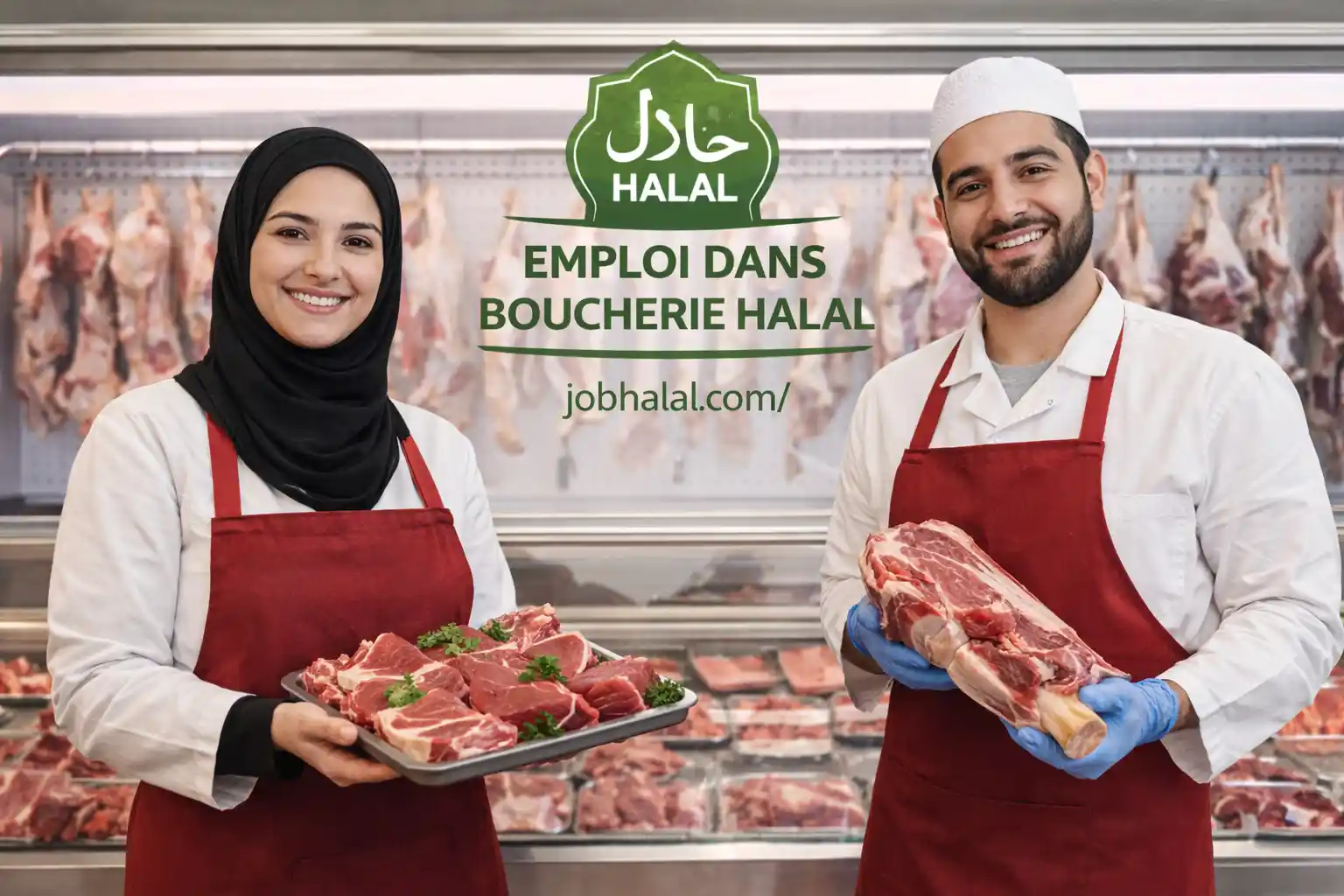
The halal butcher's shop is one of the most visible local businesses in neighbourhoods where Muslim families live. Behind the counter, the job is still that of a butcher: boning, trimming, cutting, advising and selling. On top of that comes a requirement of trust, because customers expect the meat to come from slaughter that complies with Islamic rules and never to have been mixed with non-halal products.
This page is for those who want to become butchers in a halal shop, work in an abattoir as a slaughterman, or take over a shop. It covers training, slaughter rules, hygiene and real working conditions.
Jobs in the halal meat sector
Shop butcher
The butcher receives carcasses or wholesale cuts, breaks them down into retail cuts, prepares value-added products (kebab skewers, mince, merguez sausages, marinated dishes) and advises customers. In a halal butcher's, they also know customers' particular expectations: cuts for couscous or tagine, half lambs for the festivals, offal, whole poultry.
Halal slaughterman in an abattoir
The slaughterman performs the ritual cut. He must be a practising Muslim and master the technique: a swift bleed by severing the windpipe, the oesophagus and the blood vessels of the neck with a very sharp knife, while pronouncing the name of God. In France, he must be authorised by a religious body approved by the public authorities, in addition to having the skills required of any abattoir operative.
Other positions
- Cutting and boning operative in a cutting plant or abattoir.
- Halal poultry processor.
- Butchery sales assistant and butchery counter manager in a grocery or supermarket.
- Halal inspector, responsible for checking slaughter and labelling on site on behalf of a certification body.
Training as a butcher
In France, the classic route is the CAP butchery qualification, often taken as an apprenticeship in a butcher's shop. It can be followed by a professional certificate (BP) to gain independence and prepare to set up in business, or by a vocational baccalaureate focused on butchery and charcuterie. Adults changing career often go through continuing education or the accreditation of prior experience. In the UK, butchery apprenticeships play a comparable role.
One point to anticipate: most courses and training centres include traditional charcuterie and therefore handling pork. If this is a problem for you, ask the institutions and the master butchers who take apprentices about possible arrangements, and read the page on working with pork and prohibited products to learn about the common scholarly positions. An apprenticeship directly in a halal butcher's shop is often the simplest solution.
The rules of halal slaughter
Scholars agree on the essentials: the animal must be of a lawful species, alive at the time of slaughter, slaughtered by a Muslim (or, according to many opinions, by one of the People of the Book) with the name of God pronounced, and the bleeding must be complete. The differences mainly concern pre-slaughter stunning: some accept it if it is reversible and does not kill the animal, others reject it. Certifiers adopt different specifications on this point, and customers may pay attention to it.
At European level, Regulation (EC) No 1099/2009 on the protection of animals at the time of killing requires stunning in principle, but provides a derogation for slaughter prescribed by religious rites, provided it takes place in a slaughterhouse. Member states retain some discretion, and certain European regions have restricted this derogation. Slaughter outside a slaughterhouse, including at Eid al-Adha, is prohibited in France.
Hygiene and food safety
Butchery is a job with high food safety risks. The butcher applies European food hygiene rules, the HACCP method and the establishment's food safety plan:
- strict observance of the cold chain, from delivery to sale;
- cleaning and disinfecting tools, work surfaces and cold rooms;
- batch traceability, keeping labels and documents of origin;
- separating raw and cooked products, and managing use-by dates.
For a halal butcher's, traceability serves a dual purpose: food safety and religious compliance. Keeping proof of origin and never bringing in meat from another supply chain protects the shop's credibility. The subject is developed on the page about traceability and inspection of halal products. In France, veterinary services regularly inspect butcher's shops and can close an establishment for serious breaches.
Working conditions
The job is physical. The butcher works standing up, in the cold, handles heavy loads and uses knives and saws. Cuts and musculoskeletal disorders are the most common risks; cut-resistant gloves, protective aprons and manual handling training are essential.
- Hours: early starts to prepare the display, work on Saturdays and often on Sunday mornings.
- Peak periods: Ramadan and above all Eid al-Adha, which call for very rigorous organisation of orders.
- Abattoir: high throughput, production-line work, a noisy and damp environment.
These constraints are worth knowing before committing, but demand for skilled butchers remains strong and the trade offers genuine independence to those who master it.
Opening your own halal butcher's shop
After a few years of experience, many butchers consider setting up on their own. You then need to register the business with the veterinary or food authorities, comply with the standards for fitting out the premises, choose reliable suppliers and, if possible, a certification body recognised by local customers. Management (margins, wastage, stock) is often the main difficulty. The page on independent halal retail covers the practical aspects of setting up.
Tips for finding a job
- Go directly to the butcher's shops in your area with your CV: many recruit by word of mouth.
- For an apprenticeship in France, contact the chambers of trades and crafts, which point applicants towards employers.
- State your skills clearly: boning, poultry cutting, preparing value-added products, operating the till.
- To become a halal slaughterman, approach an abattoir that carries out ritual slaughter and ask about the authorisation procedure.
- For specific religious questions, particularly on stunning, consult a qualified scholar.
The two reference lists
Sources and resources
- SMIIC – halal food committee — Technical committee that develops common halal standards for food.
- ISO — International Organization for Standardization: quality, food safety and audit standards.
- International Labour Organization — International labour standards, health and safety, conditions of employment.
- UNIDO — United Nations Industrial Development Organization, active in agro-industry and quality.
- International Trade Centre — UN–WTO agency supporting exporters and international trade, including halal.